Thesis · Chapter 4
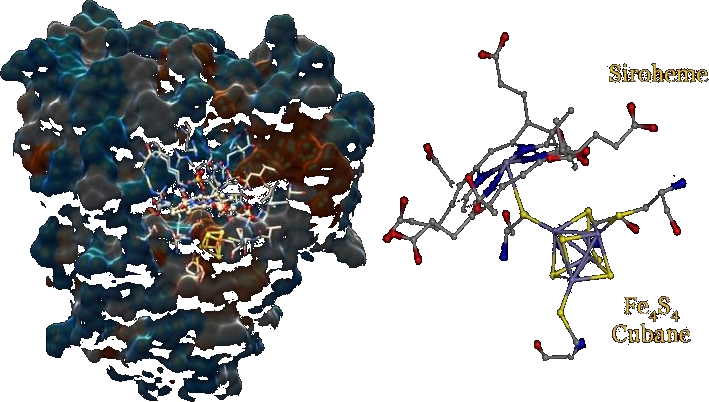
The sulfite reductase active site
That which is of importance is not to produce but to understand. And to understand means to distinguish the level of awakening that a being had achieved, its capacity to perceive the sum of unreality that enters in each phenomenon.
— Emil Cioran
The scientific core, in three movements. Pars energetica asks what the siroheme modification does to the active-site iron, showing that by relaxing the ring’s conjugation it eases the accommodation of high-spin states.
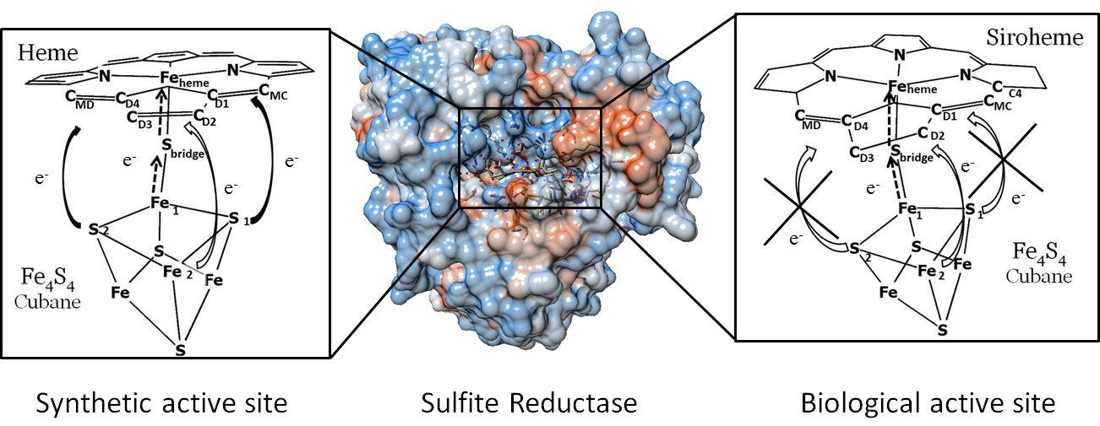
Pars ballistica answers the thesis’s sharpest question — why does the enzyme use siroheme rather than ordinary heme? — with electron-transport theory: siroheme routes electrons to the catalytic iron through the cysteine bridge while suppressing the through-porphyrin paths that would leave the ring radical-prone. Pars mechanistica then follows the full reduction of sulfite, intermediate by intermediate, with the iron–sulfur cubane shaping the mechanism throughout.