Thesis · Chapter 3
Hydrogen-rich metallaboranes
Even if our preferred “polyhedral series” thesis is found to have no theoretical basis and is simply the unlikely result of quite a number of coincidences, it should at least serve as a convenient memory aid in the teaching of this subject.
— Robert E. Williams
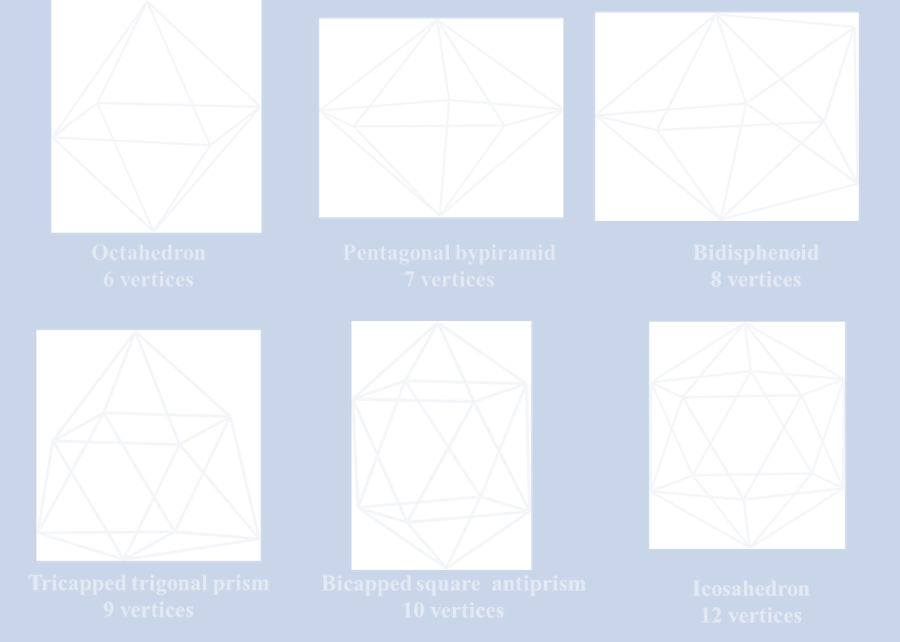
The first body of computational work. Across the second- and third-row transition metals, I mapped the preferred shapes of hydrogen-rich dimetallaborane clusters — thirty-four predicted structures spanning five- to eight-vertex cages — and related each to its skeletal-electron count through the Wade–Mingos rules.
Every experimentally known structure was recovered as the computed ground state, and three of the predictions were later confirmed by X-ray crystallography. It is the thesis’s most directly testable science: forecasting, not fitting.